Shows · Borscht Capades
Borscht Capades
Opened 1951
99 performances
Revue, Golden Age
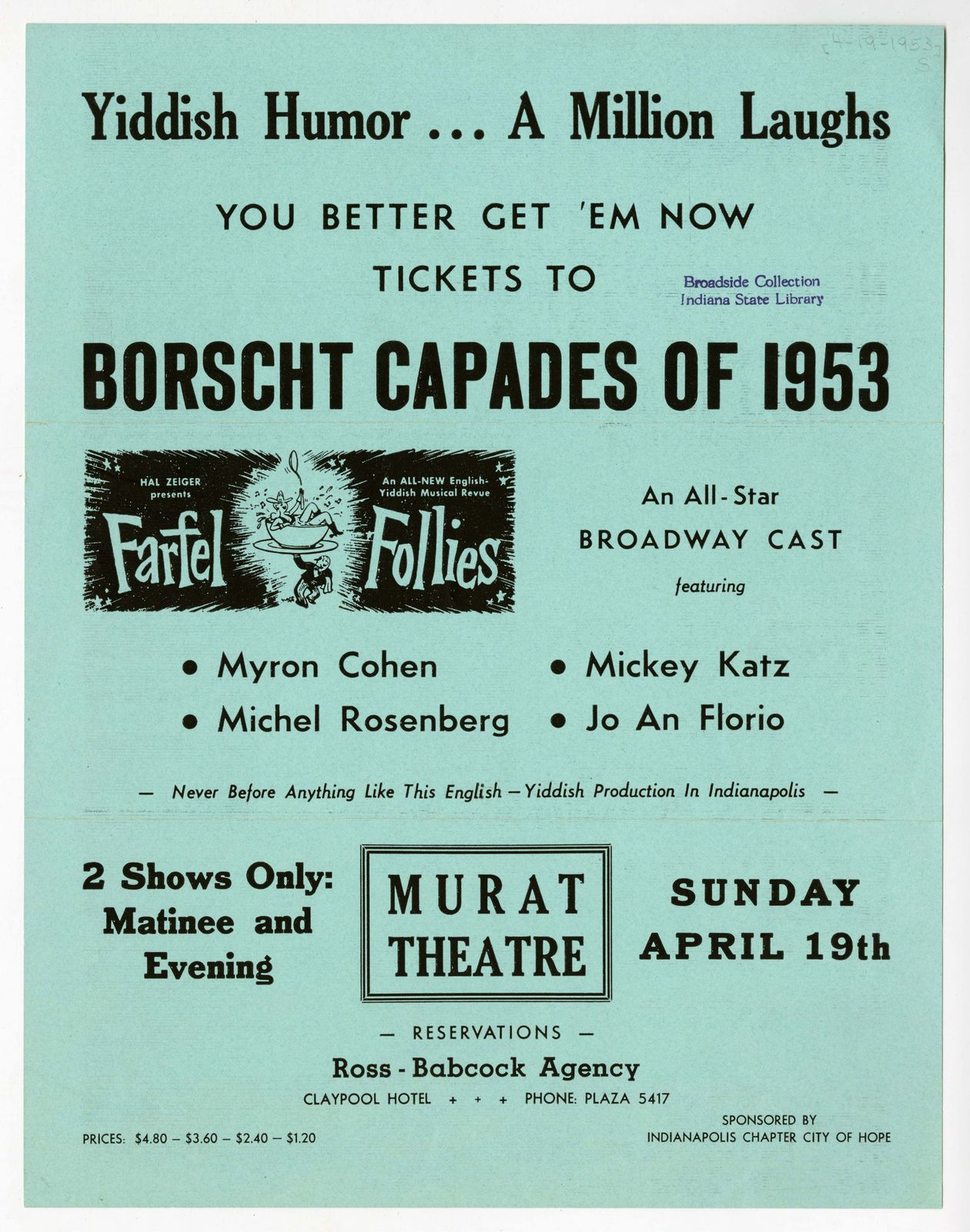
Like Bagels and Yox, Borscht Capades offered comics, singers, dancers, and a brief foray into serious Jewish music (such as the sequences “Lighting of the Sabbath Candles” and “Danse Chassidic”). Richard Watts in the New York Post said in comparison with Bagels and Yox he was almost prepared to call Borscht Capades a “masterpiece.” But he restrained himself, and was content to say the new “English-Yiddish” (as opposed to the previous “American-Yiddish”) revue was “entertaining.” While it was no “triumph of imaginative production,” at least it didn’t appear to have “been merely thrown on the stage,” and in fact there was evidence that “someone was present in the capacity of director.” Watts and Robert Garland in the New York Journal-American were also grateful that the offending microphones of Bagels and Yox were absent from the current revue, and, like Watts, Garland said the revue was “a whole lot more enjoyable” than its predecessor. Bert McCord in the New York Herald Tribune (who thoughtfully explained to his readers that “borscht” was beet soup) said the revue would have “very limited appeal.” He praised the serious singing style of Raasche and her religious-themed numbers and the comedians Phil Foster (a “Jewish Milton Berle”) and David Barry (billed as the “Professor of Fractured Yiddish,” he offered a sketch about Lincoln and Grant with a Yiddish twist), and said they were of “professional caliber” (but he found Barry’s shtick about a bar mitzvah “somewhat tasteless”). Further, Patsy Abbott was “loud and brash and in very questionable taste” (Garland reported that the second-act opening offered an “innovation” because Abbott’s “You Just Came In?” summarized in song all the proceedings of the first act). Brooks Atkinson in the New York Times said “week by week” Jewish-oriented revues were getting better. The evening was “not a floor show, but theatre,” and he noted there was actually “scenery, costumes and lighting.” He mentioned that the Barry Sisters were introduced as the Yiddish Andrew Sisters, and commented that Ted Adair’s dancers didn’t offer any “original ideas” in their numbers. Robert Coleman in the Daily Mirror found the evening “packed with melody and hilarity” (and, typically, he reported the audience blistered their palms in applause), and John Chapman in the Daily News said he had a “pleasant, chuckling good time” (as with the previous week’s revue, he noted that some audience members went wild at the mere mention of a word spoken in Yiddish). Contradicting Atkinson, William Hawkins in the New York World-Telegram and Sun said the evening was “a floor show put on a stage,” and unlike Bagels and Yox “nobody seems to be having an awfully good time.” The revue originated in Hollywood, and as Borscht Capades of 1951 toured a number of cities including Chicago, Miami Beach, Detroit, Cleveland, Toronto, and Montreal. The tour was self-described as “Hollywood’s English-Yiddish All-Star Variety Revue” and included in the cast were Mickey Katz, Dave Barry, Phil Foster, and Jack (as Jackie) Hilliard, all of whom appeared in the New York production. Also in the touring cast were Bas Sheva, Leo Diamond, Don Tannen, Pietro Gentile, Abby Lee, Grace and Nicco, and Katz’s son Joel Grey. A note in the Miami Beach program indicated a new 1952 touring edition of the revue would begin during the fall of 1951.
- Music
- Mickey Katz
- Lyrics
- Mickey Katz
Productions1 on Broadway
Songs14 songs
Yiddish Square Dance, Yiddish Mule Train, Lighting of the Sabbath Candles, From Sunset Boulevard to Lindy’s, Geshray of de Vilde Katchke, Yiddish Swing, Come On-a My House, I’m So in Love, Professor of ‘Fractured Yiddish’, From Egypt to Israel, On the Nile, Shepherd Fantasy, Danse Chassidic, Israeli Hora
Something wrong here? Correct a field or report the problem. Every change is recorded in public under the contributor licence.