Shows · Oh Captain!
Oh Captain!
Opened 1958
192 performances
Musical, Golden Age
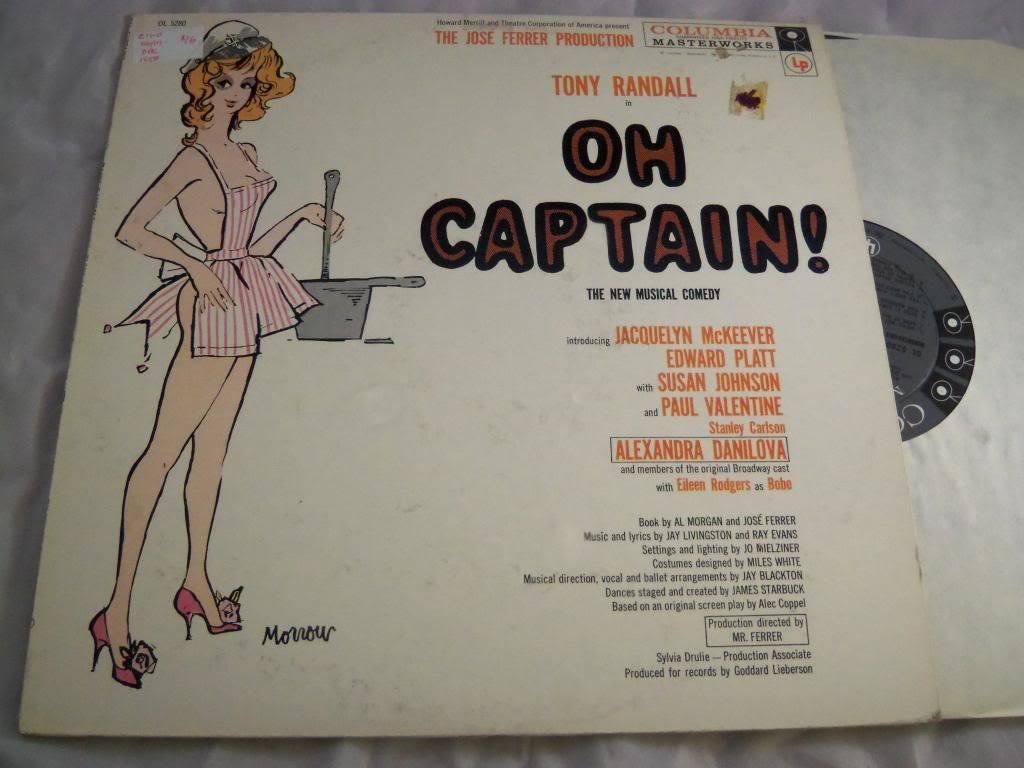
Jay Livingston and Ray Evans’s score was one of the era’s best, a slam-bang fandango of twenty-five separate old-fashioned song numbers, a wild potpourri of comic frolics, ballads, and dances. The songs cleverly delineate the characters, propel the plot forward, and provide a flavorsome and atmospheric background to the English and French locales. Livingston and Evans created three “Life Does a Man a Favor” songs that employed the same melody to describe Henry’s three-way love affair with Maud, Bobo, and the sea, and his “Three Paradises” summed up all three loves, but with the twist of using the main melody of “All the Time” (which he sings toward the end of the second act) to foreshadow that Maud is the true love of his life. The musical began with “A Very Proper Town,” a witty Gilbert-and-Sullivan-styled depiction of life in Henry and Maud’s small-town world. Maud and Bobo were each given a razzle-dazzle explanation of their secret desires, “Surprise” for the seemingly dull Maud and for the voluptuous Bobo an admission that “Femininity” is not all it’s cracked up to be. “Surprise” is one of the best show tunes ever written, and like a handful of others (such as “One” from A Chorus Line) it practically defines the magical sweep and grandeur of the classic Broadway show tune. Other delights in the score are Maud and Bobo’s confrontational duets, the rueful “You Don’t Know Him,” which is directed at one another, and the accusatory “Double Standard,” directed at Henry. Besides the haunting ballad “All the Time” (which was a hit song for Johnny Mathis), the musical offered the breezy yet heartfelt “You’re So Right for Me” (which had first been introduced in Livingston and Evans’s 1954 television musical Satins and Spurs). One or two critics noted the evening gave away its surprises too quickly by having Randall sing “Three Paradises” about half-way into the first act. While the script is amusing and quite readable, one feels the first act should have concluded with a comic explosion in which the characters discover one another’s secrets. And this discovery for the characters and the audience should have been followed by a quick blackout with a fast first-act curtain. And there should also have been a comic eureka moment in the second act when Henry suddenly discovers that Maud and Bobo are not the women he thought he knew and that they essentially want to reverse their roles. John Chapman in the Daily News said Oh, Captain! was “splendid, tuneful, witty and well-played,” and was “a new work of art in the musical comedy field.” He also noted Jay Blackton’s orchestra was Broadway’s “deftest and most sophisticated” and Jo Mielziner’s “opulent” settings included a finale in which the S.S. Paradise literally blew its stack. Robert Coleman in the Daily Mirror acknowledged the show was “no classic” but nonetheless offered a “goldmine of frolic, fun and beautiful babes.” He too praised Mielziner’s décor, and was one of six of the seven critics to single out the designer’s use of treadmills to whisk scenery and performers on and off the stage (this appears to be the first wide use of treadmills during the period, although at least one musical utilized the device during the 1940s). Frank Aston in the New York World-Telegram and Sun said the “slick and handsome” musical was “one of those rare displays of splendiferous, gaudy, songful, loud, comical, swift, dancing joy that happens none too often”; Richard Watts in the New York Post said the show wasn’t a “masterpiece” and wasn’t “sensational,” but was nevertheless “agreeable and melodious”; and John McClain in the New York Journal-American hailed Tony Randall as a “smashing new star.” Brooks Atkinson in the New York Times felt the evening was on the “level of the old-fashioned varsity show” and noted the musical had “everything except taste.” Walter Kerr in the New York Herald Tribune said “Three Paradises” gave away the show’s surprise too soon (“it’s like identifying the Mystery Guest before the program has started”); remarked that “Surprise” was the score’s highlight; that Abbe Lane was “better constructed than the plot”; and that the “bouncy” score seemed to belong to an upcoming musical film titled The Big Broadcast of 1958. The delightful original cast album was recorded by Columbia (LP # OL-5280) and released on CD by DRG (# 19030), but perhaps it was not quite “original” because for the recording Eileen Rodgers performed Abbe Lane’s songs. Lane was under contract to RCA, and the company wouldn’t allow her to participate in the cast recording; but for her RCA album The Lady in Red (LP # LSP-1688) she recorded two songs from the musical, “Femininity” and “We’re Not Children” (while she had introduced the former in the musical, the latter was a seduction tango performed on stage by Jacquelyn McKeever and Paul Valentine). There were three other recordings of the score: The Ferrers—Rosemary Clooney and Jose Ferrer Sing Selections from the Broadway Musical Com
- Music
- Jay Livingston and Ray Evans
- Book
- Al Morgan and Jose Ferrer
Productions1 on Broadway
Songs22 songs
A Very Proper Town, Life Does a Man a Favor (When It Gives Him Simple Joys), A Very Proper Week, Life Does a Man a Favor (When It Leads Him Down to the Sea), Captain Henry St. James, The Dock Dance, Three Paradises, Surprise, Life Does a Man a Favor (When It Puts Him in Paree), Hey, Madame, Femininity, It’s Never Quite the Same, We’re Not Children, Give It All You’ve Got, Love Is Hell, Keep It Simple, The Morning Music of Montmartre, You Don’t Know Him, I’ve Been There and I’m Back, Double Standard, All the Time, You’re So Right for Me
Recordings 1 recording
Licensing 1 entry
| US | Concord Theatricals Tams-Witmark | available |
Something wrong here? Correct a field or report the problem. Every change is recorded in public under the contributor licence.