Shows · The Threepenny Opera
The Threepenny Opera
Opened 1954
95 performances
Musical, Golden Age
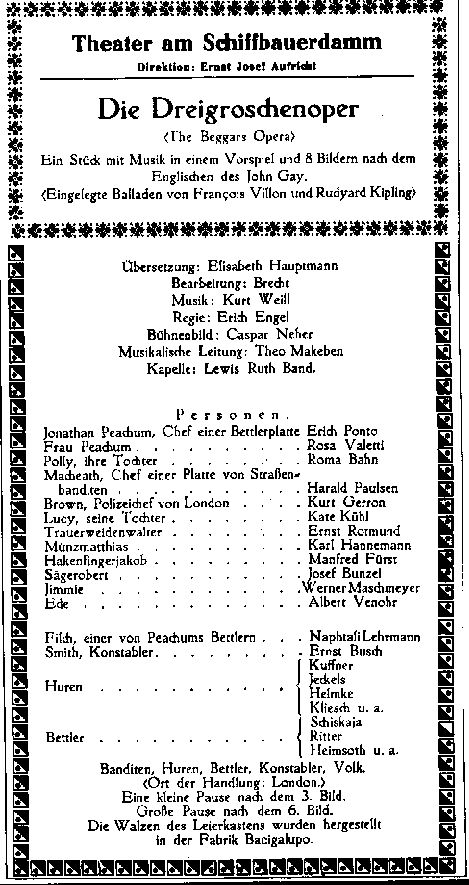
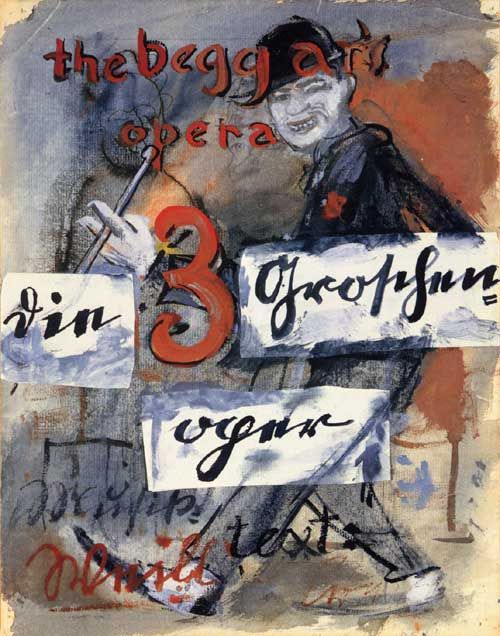
The reason for the two engagements noted above is that the initial showing of Marc Blitzstein’s English-language version of the Kurt Weill-Bertold Brecht Die Dreigroschenoper at the Theatre de Lys (now the Lucille Lortel) had to be terminated because of a prior booking. Led by critic Brooks Atkinson, public demand brought it back 15 months after the closing, with cast replacements including Frederic Downs for Leon Lishner, Jane Connell for Charlotte Rae, Tige Andrews for Gerald Price, Eddie Lawrence for Joseph Beruh, and Chris Chase for Gerrianne Raphael. At this writing, the return engagement is the second longest running production ever mounted Off Broadway. In its original form, the work was presented in Berlin in 1928 on the 200th anniverasy of The Beggar’s Opera — credited as the first ballad opera, or musical comedy — on which it was based. The play’s bitter, raffish view of contemporary morality, combined with its jingly, beer-hall tunes, quickly made it a favorite throughout Europe, and in 1933 the first American adaptation had a brief run on Broadway. Set in Victorian London, The Threepenny Opera spins the tale of Macheath (Scott Merrill), an outlaw known as Mack the Knife. Mack marries Polly Peachum (Jo Sullivan), the daughter of the leader of Soho’s underworld, but he is betrayed by his in-laws and is sent to Newgate Prison. After being freed by Lucy Brown (Beatrice Arthur), the police chief’s daughter, Mack is again betrayed — this time by Jenny the whore (Lotte Lenya, Weill’s widow, who had originated the role in Berlin). Sentenced to be hanged, Mack receives a last-minute reprieve from the queen, thus providing the play with a mock-heroic ending. Among the more than 200 actors who played the 22 parts during the show’s run were Carole Cook, Valerie Bettis, and Dolly Haas (Jenny); James Mitchell and Jerry Orbach (Mack); Pert Kelton and Nancy Andrews (Mrs. Peachum); Georgia Brown (Lucy); Edward Asner (Peachum); and Estelle Parsons (Mrs. Coaxer). The 1964 film version featured Hildegarde Neff and Kurt Jurgens. In 1976, Joseph Papp’s New York Shakespeare Festival at Lincoln Center offered an even more abrasive version of The Threepenny Opera in an adaptation by Ralph Manheim and John Willett. With a cast headed by Raul Julia (Mack) and Ellen Greene (Jenny), the show also played Broadway for a total run of 307 performances. The Beggar’s Opera, the 18th Century English musical that had inspired the German version, was first presented in America in 1750. Its most recent production was in 1972 when the Chelsea Theatre of Brooklyn staged a revival that was also shown at an Off Broadway theatre in Manhattan. It ran 253 performances. Another variation, Beggar’s Holiday, updating the scene to modern America, opened on Broadway in 1946. The music was by Duke Ellington, the lyrics and libretto by John Latouche, and the cast included Alfred Drake, Zero Mostel, and Bernice Parks. The Golden Apple. Salesman Jonathan Lucas displays his wares for K
- Music
- Kurt Weill
- Lyrics
- Marc Blitzstein
- Book
- Marc Blitzstein
Productions6 productions: 5 on Broadway, 1 elsewhere
Songs9 songs
The Ballad of Mack the Knife, Army Song, Love Song, Pirate Jenny, Tango-Ballad, Ballad of the Easy Life, Barbara Song, Useless Song, Solomon Song
Recordings 6 recordings
Something wrong here? Correct a field or report the problem. Every change is recorded in public under the contributor licence.